Showing posts with label Ronald Reagan. Show all posts

Friday, August 9, 2013

Reagan, Thatcher, Gorbachev, Machiavelli... Where are they now?


Poor Nicolo Machiavelli!  He really gets a bad rap, doesn’t he?  I mean, just because the well-worn phrase “the end justifies the means” can be traced to his masterwork, The Prince, that doesn’t mean he was a bad guy, does it?  But, that’s the way he’s perceived.  Even people who don’t know what he has written or who he is know that a “Machiavellian scheme” is a bad thing.

More high-minded people point to how he turned the concept of a virtuous society on its head.  The ancient Greek philosophers – Aristotle and Socrates – defined a virtuous society as the result of the good works of its citizens.  To their way of thinking, the means were more important than the end.  Old Nick turned that concept of virtue on its head.  To him, virtue was about being crafty, astute or sly.  It referred to the ability of a leader to deal with whatever comes their way – to be decisive and get results.

The Prince was a handbook for the heirs to the Medici fortune not a blueprint for utopia.   The Greeks were idealists.  Machiavelli was a pragmatist.

Most often this blog turns on “issues” and policies.  I am an issues-oriented guy and those who take the time to read this fit the same mold.  We decry the misguided media and wonder aloud why the mass of voters doesn’t seem to care about the issues.  We parse the words of political candidates as if they will actually do (or have a chance to do) what they promise in campaigns.  Naïve idealists that we are, we actually think that policy matters more than politics and that what politicians say, they should do.

Alas, most political leaders have no opportunity to pursue the policies on which they campaign.  Some have no illusions.  They campaign to get elected.  Others may be sincere but their best intentions are overcome by events.  The administrations of LBJ and the much-maligned Jimmy Carter were not defined by their political campaigns.  They were defined by what the world handed them, the Vietnam War and the Iranian hostage crisis, respectively.

What was handed Ronald Reagan and Margaret Thatcher was Mikhail Gorbachev.  What was interesting is that Gorby brought them an opportunity to pursue ideas in which they believed (unlike the duo mentioned above).

More than any world leader in the 80’s, Gorbachev determined how the 20th Century would draw to a close.  His policies of “perestroika” (restructuring)and “glasnost” (openness) led to freely contested elections and liberalization of the economy.  He foresaw the economic collapse of the Soviet model and hastened it.  The Soviet Union may not have gone so quietly had it not been for Gorbachev, a pragmatist who saw that he didn’t have the resources to continue the Cold War.  Would we think of Reagan and Thatcher in the same way had the Soviet Union dragged on for another decade or two?  How about Helmut Kohl?  Could he have unified Germany and worked with Mitterrand toward the development of the European Union?

In 2000, George Bush campaigned against Clinton’s policies in the former Yugoslavia, calling it nation building, a policy that often results in failure.  But, 9/11 changed everything.  Bush soon found himself nation building in Iraq and Afghanistan.

His successor, Barack Obama, campaigned against Bush’s policies in those two far away lands.  Once inaugurated, he was off to the Middle East to address the Arab public so as to differentiate himself from his predecessor. But, the financial crisis and his response to it define his first term more than any ideology he espoused. 

It was not the policies on which Bush and Obama campaigned that mattered.  It was their character and their ability to make a decision in moments of crisis and stick with them. 

It’s great to focus on policy as a framework for the direction of the country (any country).  However, it’s naïve to think that the political and international landscape is so benign as to permit a candidate to actually follow their prescription for governance.  It is usually a crisis and a leader’s response to it that defines their tenure.  And, it’s their ability to embrace the Machiavellian concept of virtue that determines their success. 

Policy wonks may decry the way in which the media – and most voters – focus on personality or, to put in high-mindedly, character of the candidates.  But, at the end of the day, character is more important than policies. 

WHO WILL LEAD?

Saturday, June 1, 2013

An Oxymoron: Future Conservatives


A few weeks ago, I wrote a post titled "I think I'm Turning Liberal...  I Really Think So".  The piece was a critique of the current liberal paradigm in this country and I got lots of responses.

Conservatives could benefit from some self-reflection as well.  To recapture a majority, they must evolve their approach to governing.  Is it an oxymoron to think of conservatism evolving to some future state? Conservatives focus on traditional values not evolution of their values.

Today’s American conservatives often quote the founders, using the U.S. Constitution as a construct for pursuing a 21st Century policy agenda.  The Constitution reflects the philosophies of Spinoza, Locke and Voltaire.  A philosophy that promoted civil liberty, political freedom, limited government, the rule of law and free markets -- tenets that today’s conservatives continue to espouse.  The irony is that, during the Age of Enlightenment, the term that defined these tenets was “Classical Liberalism”. 

That what was liberal at our founding is conservative by 21st Century standards is perhaps a measure of how societies evolve.  Can conservatives achieve any political gains with a public that seems to be moving in the opposite direction?  Do conservatives have to embrace some of the philosophical and political prescriptions of liberals to regain their electoral mojo?  I don’t think so.

People don’t vote on the basis of philosophical prescriptions; they vote for what resonates with them emotionally.  That’s why the President could be elected on the flimsy promise of “Hope and Change”. 

But Ronald Reagan’s “Morning in America” theme during the 80’s was no more substantive; and, no Republican has been able to connect with the emotional core of the public the way that Reagan did in the years since. 

The nation needs real reform.  Conservatives understand that our debt and deficits are not sustainable.  They understand that our entitlement programs need restructuring to survive.  There are big changes required to get the country on track. 

Reagan understood that big change requires big majorities.  You can’t persuade the majority by standing at one end of the political spectrum, hurling epithets at the other.  Reagan’s “Morning in America” pitch was optimistic about our future at a time when we were also in crisis.  It was the faith he expressed in America that sold the voting public on his vision. 

The public and the media have focused on the excesses of Wall Street and the failures of a capitalist economy to support its middle class.  While some of the criticism is deserved, what is undermining the middle class is not capitalism but a government that is undermining the value of the assets we have worked so hard to accumulate. 

At their core, Americans – no matter their race, gender, ethnicity or sexual preference – are aspirational.  That is, our culture fosters ambition and self-sufficiency.  Aspirational Americans may wish for their government to provide assistance to the most needy; however, they do not wish for a segment of the population to be motivated not to work. 


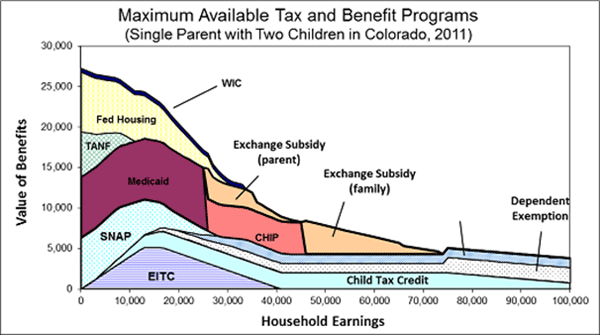
If you eyeball this chart, you can see that an individual making an annual salary of $25,000 receives the equivalent of $20,000 per year in government assistance.  It’s pretty hard to improve your annual income by 80% and it’s unlikely that many will try if they will lose the equivalent in government support.

Aspirational Americans don’t wish for their hard earned wealth to be shared in this way.  All they want is an opportunity to succeed on their own merits.  They want access to a great education, equal opportunity for employment and civil liberties -- values that are consistent with classical liberals, our founders.  Conservatives preach these values but often don’t live up to them.

Instead, Republican politicians support corporate America.  Support that manifests itself in subsidies for ethanol, tax breaks for big oil and tax exempt bonds for corporate projects.  The founders never intended the government to be at the behest of corporations. It is supposed to serve the people.  Thomas Jefferson is rolling over in his grave.

Conservatives like to quote Adam Smith’s work “The Wealth of Nations” and speak of the “invisible hand” of the market as a the cure for what ails us.  But, they should also remember Smith’s words about government. "Civil government, so far as it is instituted for the security of property, is in reality instituted for the defense of the rich against the poor, or of those who have some property against those who have none at all.”

They can regain their electoral mojo without sacrificing their values.  They just need to start practicing what they preach.   

WHO WILL LEAD?

Sunday, October 7, 2012

This Is Your Brain… This Is Your Brain in the White House


I am beginning to be glad I am such a dummy.  Have you noticed how the smart guys really screw things up?  All those smart guys in Washington got us into a war in Iraq.  Oops, no weapons of mass destruction.  All those smart guys on Wall Street bought into the mortgage mess.  Oops, the mortgages weren’t worth the paper they were printed on.  All those smart guys in the Silicon Valley convinced themselves that IPO’s of pre-revenue startups were a great investment.  Oops, the tech bubble bursts.

Ever since the Age of Reason, we have convinced ourselves that we are rational human beings.  The central concept is that reason should overrule emotion.   So, we rationalize everything, convincing ourselves that our rational mind is in charge.  Our leaders – government and corporate -- are no more or less immune to this phenomenon than are we.   To make matters worse, we are now converting our best reasoning into software, moving to a society ruled by algorithms. Wall Street runs their trading operations by computer.   Computers write news reports for Forbes magazine.  And, Wal-Mart’s computers automatically generate orders to their suppliers when their stock runs low.

Now, the math geniuses behind this trend are preparing us for robots that will clean our houses (think Roomba on steroids) and cars that will drive themselves. 

We can’t trust the tech industry with our credit card numbers.  Now, we are going to have them drive our kids to school?

All of this is going on within the context of recent studies of brain science that suggest we are not simply moved by math.  We are motivated by emotion and our success is a function of the human cocktail that blends both sides of the brain. 

Karl Albrecht, Ph.D
I had been thinking about this when someone sent me a link to Psychology Today’s website.  The blog post (Brain Snacks), written by Karl Albrecht, Ph.D. delineated recent presidents along the lines of the type of thinker they are.  It divided them into two spheres – left brain is Blue and right brain is Red.  And, it further identified the high concept thinkers (Sky) and the pragmatists (Earth).  So, there are four possible combinations. 

Dr. Albrecht is careful to disclaim any notion that he is certain of his analysis.  After all, he hasn’t examined the “patients”.  That said, he believes he has had enough opportunity to observe the style of recent presidents to reach some tentative conclusions.  Ronald Reagan was both a Red Earth and a Red Sky.  Bill Clinton, a Red Sky.  Big thinkers with a vision, he says. 

Not so, the current contenders to be our nation’s chief executive.  Obama, according to Albrecht, is a Blue Earth thinker while Romney is likely a Red Earth.  “If you’re hoping for a Reaganesque ‘new America’ narrative, for example, don’t hold your breath,”  says the good doctor.  “Whoever wins, it’ll be all about tools and tool belts.”

He goes a step further and claims that even the programs that the two candidates propose will not matter a whole lot.  “Very few of them will survive the first collision with the Congress and the lobbyists,” he says.  “Ultimately, what matters is the individual leader’s ability to deploy his or her particular kind of intelligence, and his or her cognitive orientation, in a way that can mobilize people and resources to get the big things done.”

George Friedman
I have reported on the writings of Stratfor founder George Friedman in the past (Hey, We Had a Deal... Didn't We?).  He has observed that we have had a crisis that gave rise to a strategic president who made big changes to the way we are governed about every 50 years.  Most recently, it was Ronald Reagan.  Friedman does not suggest any reasons that it’s 50 years.  He just makes the observation.

I had been hoping that the current crisis might give rise to a strategic presidency – one which would make big sweeping changes to our entitlement programs, our fiscal circumstance and our social policies -- someone who might shorten the 50 year cycle.  But, if Dr. Albrecht is correct, we’ll have to wait a little longer.  Pragmatists like Obama and Romney are not guided by ideology.  They focus on what can get done. 

What they can get done is important.  However, how they LEAD is more so.  Reagan was able to convince Democrats to vote against their own interests.  Clinton forged a path contrary to his party’s ideology on trade and fiscal matters.  Bush imprinted our nation with a new security paradigm following 9/11. 

So, what happens next?  Can either of the current candidates LEAD us to a more sustainable economic future?  Or, should we just find an algorithm to do the job?

Monday, July 23, 2012

The Right is Wrong and the Left is Not Right


I like to think of myself as a political moderate.  And, it must be true since I managed to irritate both conservatives and liberals with my last post, Good, Better, Best... Never Let It Rest.

Oh, I got a few “atta boys”.  “Nice job, John”  “Keep it up”, etc.  However, overwhelmingly, I got the type of response I was hoping not to. 

It boils down to this:  the Right believes that Obama is a Socialist and that there can be no compromise with that element.  The Left rationalizes Obama’s record of economic non-achievement by citing irrelevant examples. 

Well, in the interest of continuing to irritate both sides, let me just say it:  The Right is Wrong and the Left is Not Right. 

There is an emerging monologue among those on the Left.  They postulate that government should raise taxes, invest in infrastructure and that somehow private enterprise will invest in R&D and create jobs.  One respondent asserted that “trickle down” doesn’t work but that “trickle up” does.  Their example is the 1950’s, a decade of the highest growth in our history coincident with the highest tax rates in our history.  I like to point out that “correlation is not causation”.  That high growth coincided with high taxes does not mean that taxes don’t reduce growth.  But, that seems to fall on deaf ears.

The major objection I have to this line of thinking is that no one wants to believe the data.  And, the data show that government spending does not get a financial return.  The “multiplier effect” where a dollar of capital investment gets 2 dollars in return has been shown to work with private investment but not with government spending.  There have been numerous studies demonstrating this result.  I will point out just one.

Liberal economist, Christine Romer, President Obama’s first Chair of the Council of Economic Advisors, wrote "The Macroeconomic Effects of Tax Changes" while she was an economics professor at University of California at Berkeley in 2007.  She concludes, in part, that “tax increases are highly contractionary. The effects are strongly significant, highly robust, and much larger than those obtained using broader measures of tax changes. The large effect stems in considerable part from a powerful negative effect of tax increases on investment.”

Investment has a multiplier effect on GDP and improves employment prospects.  True, robust growth in the 1950’s was coincident with high tax rates.  It is also true that robust growth in the 19th Century was coincident with NO income tax. 

Now, I am not saying we should reduce taxes or even that we shouldn’t increase taxes.  I am simply saying we need to understand the impact of taxes and ask ourselves how much growth we are willing to sacrifice for the government we want. 

Conservatives for their part advocate further tax reduction.  The Supply Side theories of Arthur Laffer were the underpinning of Reagan’s economic policies and they have served us well.  They are right.  They served us well for about 20 or 25 years.  However, in the last decade middle class wages have stagnated while the costs of healthcare and education have skyrocketed. 

As for “trickle down economics”…  Well, there is no such proven economic theory.  It’s more of a political phrase than an economic theory.  And, lately, not much is trickling down. 

Governance is more than just economics.  In colonial times, our founding fathers recognized the need to address the common good, the need to place each selfish and separate interest in the context of the “res publica”, literally the “public thing”. 

Conservatives need to recognize that government should play a role in helping its people through the transition to a global economy and liberals need to recognize that we need a sustainable financial platform to provide for it.

In his Sunday Op-Ed piece, author and New York Times columnist Tom Friedman advocated that we focus on supporting entrepreneurship and suggested “…we should aspire to be the world’s best launching pad because our work force is so productive; our markets the freest and most trusted; our infrastructure and Internet bandwidth the most advanced; our openness to foreign talent second to none; our funding for basic research the most generous; our rule of law, patent protection and investment-friendly tax code the envy of the world; our education system unrivaled; our currency and interest rates the most stable; our environment the most pristine; our health care system the most efficient; and our energy supplies the most secure, clean and cost-effective.”

Our political debate should be about how to achieve the objectives so concisely presented in Friedman’s column.  Instead we have, thus far, been treated to more of the same unproductive, partisan nonsense that has caused us to fail to address our long term challenges since the turn of the century.  Is it any wonder that an increasing number of voters identify themselves as independents.?

Obama and Romney are serious, intelligent people with a sincere desire to advance the American cause and very different approaches to doing so.  I can only hope that the presidential debate will turn to that discussion.

WHO WILL LEAD?

            Recommended reading:

                        The Center on Budget and Policy Priorities
                        The Microeconomics Blog
                        Proceedings of the National Academy of Sciences of the United States


Sunday, June 24, 2012

Hey, We Had a Deal… Didn’t We?

George Friedman

While shopping for a car last weekend, we met TJ.  He is one of those guys who really should be a salesman.  He is always happy to see you and always has a smile on his face.  He’s the kind of guy everyone wants to be around.  TJ has been selling cars for 30 years.  “What did you do before that?” I asked.  “I was an air traffic controller,” came the reply with a chuckle. 

Remembering my late 20th Century history, I observed he must have been one of those guys put out of work by the PATCO strike.  He was.  “I bet you didn’t vote for Ronald Reagan in 84,” I said.  Laughing again, he admitted I was right. 

TJ didn’t know it at the time but his plight was at the leading edge of a strategic shift.  Stratfor founder, George Friedman, has observed that there have been four such shifts in our history.  Each was brought about by a paradigm that had run its course and a crisis that brought about a failed presidency that was followed by a seminal presidency.  These shifts have occurred approximately every 50 years.  The failed presidency of John Quincy Adams was followed by Andrew Jackson.  A half century later, Grant was followed by Hayes.  Then came Hoover and FDR and, one that many of us remember, Carter followed by Reagan. 

The conditions of the Great Depression made it politically feasible for FDR to create programs that supported the poor, the elderly and the working class.  The term "social safety net" was coined by one of the most conservative economists of that time, Friedrich Hayek.  Social Security, unemployment insurance and the Civilian Conservation Corps were seen by many as a way of placating a wave of immigrants who were accustomed to socialist or social-democratic governments.  By offering the safety net, the lower economic classes were less likely to join truly socialist movements.

Friedrich Hayek
During this half century phase, government was designed to plan, regulate and control economic and social outcomes.  The extremely high tax rates of the Truman and Eisenhower years were necessary not only to pay off the debt accumulated by WW II but also to support the regulatory state. 

For two generations following the war, business, government and organized labor worked in concert to create a domestic economy that served our needs.  Our schools and universities turned out students who were well equipped for the economy of that time.   Those who were fortunate enough to go to college joined the management of big companies like AT&T, GM and IBM.  The rest joined unions and worked in the factories.  Everyone expected to be employed for life by the same company and many, if not most, were. 

But, high tax rates took their toll on capital investment; and, by the 1970’s, foreign competition was taking its toll on the union model.  Globalization meant American companies needed to update their factories and had to compete with low labor cost nations like Japan.   

The Reagan revolution would not have happened if the economy were not in shambles.  He sold us on a vision that undermined the model on which the populace had come to rely.  He used the PATCO strike as a public demonstration that the unions could be broken.  In the 30 years since, union membership has dropped from 30% of the workforce to 7%. 

I don’t remember Reagan ever announcing that he was changing the social contract.  But, it certainly changed during his administration.  Fixed benefit pensions were replaced by 401K’s.  To compensate for rising healthcare costs, corporations introduced HMO’s to replace traditional health insurance.  American corporations needed to become more nimble to compete on a global stage.  Lifetime unemployment was out; flexible workforces were in. 

Under this new paradigm, the American economy boomed for three decades on the strength of the wealth effect from the establishment of two income households, the stock market boom of the 1990’s and the rise of home values in the 2000’s.  But, just as FDR’s model of government had started to fray by the 1970’s, the Reagan revolution has started taking its toll on the middle class.  Globalization has flattened incomes, corporations pass on more of the cost of health and pension benefits to their employees and the cost of a college education is skyrocketing. 

The national political debate seems to be a continuation of FDR vs. Reagan.  But, would either of those models work today?

The booming economy of the 1950’s was coincident with the highest tax rates in our history.  But, anyone who has ever taken a course in logic knows that correlation is not causation.  Perhaps if you could create all the other factors at play in the 1950’s – lack of foreign competition, a balanced federal budget, population growth – you could replicate the economic outcomes. 

Similarly, the 1990’s boomed with improvements in corporate efficiency, technological innovation, low tax rates and a balanced budget.  Can we replicate those conditions again? 

At their core, Americans want the same things no matter their political beliefs.  We want security at a national and local level for our families and property.  We want the opportunity to improve our standard of living.  And, we want to fulfill our role on the global stage – international leadership. 

There is an underlying need for financial stability that will provide a platform for achieving our goals in these areas.  And, there are significant challenges to providing that stability. 

Politicians at the local and state level are taking on those challenges.  Republicans like Scott Walker of Wisconsin and the “love-him-or-hate-him” governor of NJ, Chris Christie, make headlines because the media likes conflict.  But, there are significant reforms being made to pensions by Democratic governors in Rhode Island and New York and at the local level in San Jose and San Diego, CA. 

Beneficiaries have a moral right to say “hey, we had a deal, didn’t we?”  But, the hard reality is that they will have to make a sacrifice in order to get something or run the risk of getting nothing. 

We have the same risk at a national level.  Baby boomers will drain the coffers of Social Security and Medicare.  Rising healthcare and education costs are undermining middle class standards of living.  Our infrastructure needs a serious overhaul and modernization.  And, we are competing with the rising economies of Brazil, China, India and others. 

So, why are we still debating 1932 vs. 1982?  Do we really think either of those solutions sets would work today?  The issues of today are structural and strategic.  Compromise and sacrifice are called for.  The leaders who will get us out of this quagmire are those with the vision to craft a solution, the charisma to get the public to embrace it and the political skill to overcome the momentum of special interests.

So, I ask you…  Who will that person be?  WHO WILL LEAD?